Affordable Housing in Summit: A Primer
In 2024, New Jersey's Democrat majority in Trenton approved far-reaching amendments to our state's affordable housing law.
Take a drive in any direction from town, and everywhere you go, you will see the same gigantic, cookie cutter blocks of Soviet-style multifamily housing covering every inch of buildable land. What you see is the direct result of these new dictates for affordable housing.
The new affordable housing law requires Summit to add 345 affordable housing (AH) "credits" over the next ten years. AH "credits" can be new units, deed-restrictions on existing units, rehabilitation of existing units and bonus credits. The 345 number is what Trenton has decided that Summit owes as it "fair share" of affordable housing, based on a complicated formula that looks at projected population and job growth over the next 10 years.
Every ten years, a new "Round" of AH begins: a municipality must add even more AH development to satisfy unrealistic “unmet need” requirements, which further increase population density. The goal of the law is to achieve zero “unmet need” by the end of each 10-year Round.
Summit, like all New Jersey municipalities, was required to submit a "Fair Share" plan in the fall of 2025, demonstrating that its zoning laws create a "realistic opportunity for providing" its dictated fair share of affordable housing. Importantly, the affordable housing law does not require Summit to actually build the new units, but rather to use its zoning to facilitate the building of them.
Summit, like many towns in New Jersey (the most densely populated state in the country) has almost no vacant, buildable land. The challenge, therefore, is obvious: how in the world can we realistically cram in so many affordable housing units? Before this new law was passed, built-up towns like Summit were able to use a "vacant land adjustment" to reduce the gigantic number. The new law, however, made that adjustment more difficult to use. Luckily, our skilled planning professionals were able to find sufficient credits for Summit to be in compliance.
Q1: What is “Mt. Laurel” and the affordable housing law and what politicians support it?
Mt. Laurel refers to the 1975 and 1983 N.J. Supreme Court decisions, codified in 1985 into New Jersey's "Fair Housing Act". This law requires municipalities to use their zoning laws to facilitate affordable housing, ostensibly to remedy historical redlining in N.J.
Since 1985, however, the law that started as a bipartisan effort, with the noble purpose of increasing living options for low and medium-income families, has been hijacked by the "Affordable Housing Industrial Complex." The true beneficiaries of the new law are the members of the "Affordable Housing Industrial Complex: Fair Share Housing Corporation (a non-profit, housing activist group), developers, well-paid lobbyists and Democrat politicians. In the name of creating AH, the new law enriches developers and politicians, and results in overdevelopment. It has robbed municipalities of local control over their own zoning, forcing leafy suburbs like Summit to become mini-cities overnight.
The new law was approved along party lines, with Trenton Democrats unanimously voting in favor. Although many Democrat voters are against the resulting overdevelopment, local Democrat politicians like the Summit Municipal Democratic Committee (SMDC) either support Trenton Democrats or don't dare speak out against them.
Q2: Is it true that to achieve 345 new AH credits, Summit must build 1725 new housing units?
No. Typically, municipalities achieve their AH credits through new "inclusionary" development, where the developer includes one affordable unit out of every five units it builds. The economics of construction demand this affordable-to-market-rate ratio because the market-rate units subsidize the cost of building the affordable units and the negative returns on them.
In AH projects that are 100% affordable, as opposed to inclusionary, the Summit taxpayers foot the bill. The land for the housing project must be paid for and donated by taxpayers, or paid for by a mortgage guaranteed by Summit taxpayers. The AH properties generate zero tax ratables by relying on "PILOT" agreements (Payment in Lieu of Taxes"), depriving our schools of any income, even as these projects add school children to our town.
Municipalities may also use existing housing to earn AH credits, through rehabilitation or by negotiating 40-year deed restrictions that require the owner to rent units at the lower rates set in the AH legislation. Municipalities may also obtain bonus credits by reserving affordable units for certain groups, like veterans and special needs.
The 2024 and 2025 Together for Summit Common Councils worked creatively to achieve 345 credits to satisfy Summit's unmet need with the fewest possible new residential units. Unfortunately, the current SMDC-led Council appears determined to change this plan to Summit’s detriment.
Q3: How many total "new" units does the current Round 4 plan call for and what is the breakdown?
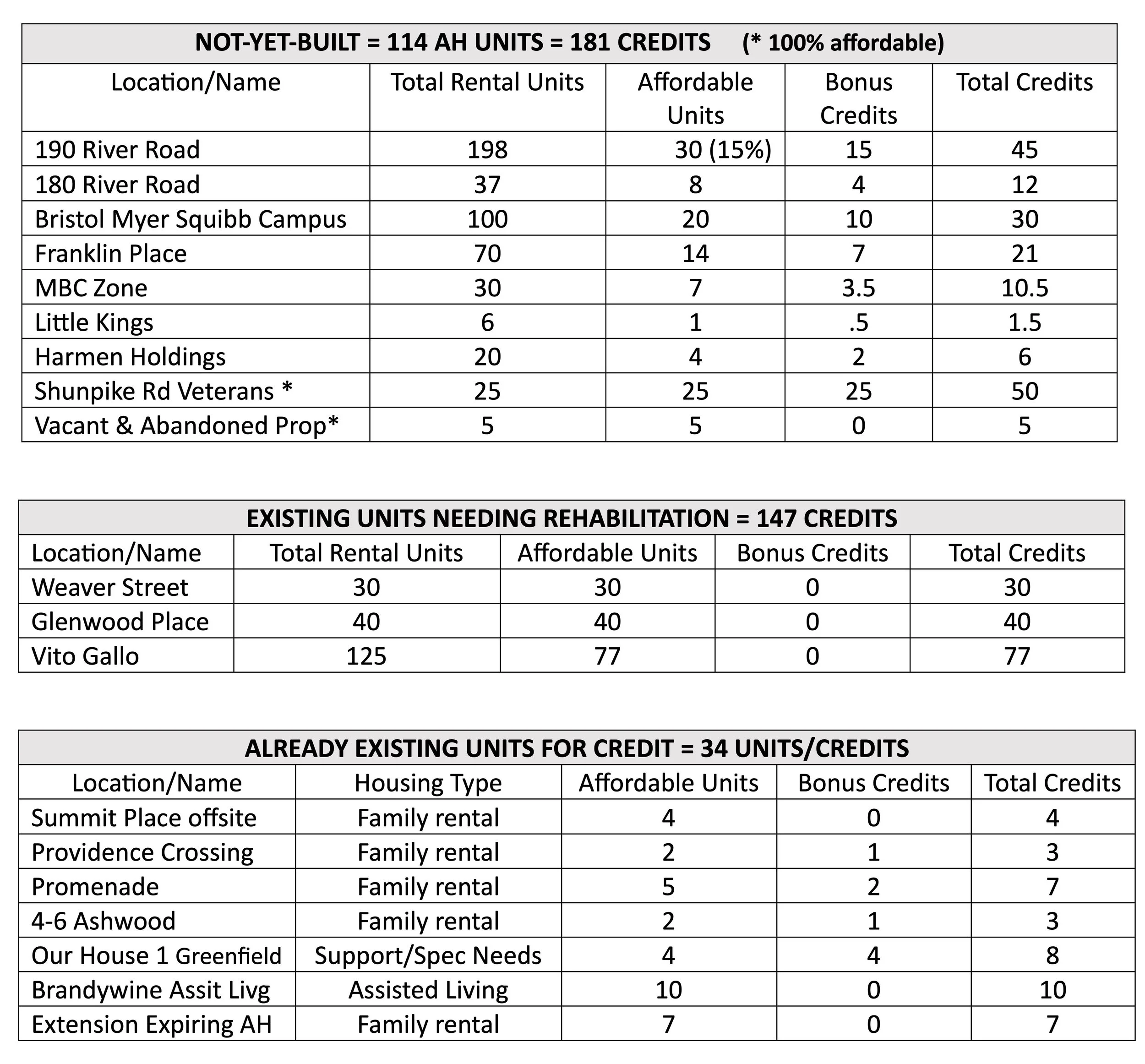
Our Round 4 plan calls for a total of 295 "new" units, and achieves 370 total AH credits, which is 25 more creditsthan the State-required 345. The 25 surplus credits can be applied to future Rounds.
To be clear, the word "new" when used for 295 "new" units doesn't mean "new" as in "not-yet-built." It confusingly includes some already existing housing units that can be counted. In clearer terms, the 295 "new " units consist of 181 already existing units and 114 not-yet-built affordable units. The reason that this matters is obvious: Summit must struggle to find buildable land to accommodate the required not-yet-built units.
The bottom line is that Summit has completely fulfilled our "unmet need" for Round 4. This is a major accomplishment by the Together for Summit Council and the City's planning professionals, given the completely unrealistic state mandate.
Q4: How does/will Mt. Laurel impact Summit’s schools?
It inevitably will lead to larger class size, redistricting, and most likely expensive expansion of existing schools or the construction of new ones at significant cost to taxpayers.
Q5: Why is so much of Summit’s new AH development in East and West Summit?
That is where the available, buildable land is.
Q6: Did Summit negotiate with any developers to be a part of its Round 4 plan?
Yes. The current SMDC Council is likewise negotiating with the owner of the Bristol Myers Squibb for hundreds of new units and another developer who wants to build a six-story development on the corner of Broad Street and Summit Avenue, aka "Broad Street East".